10 Practical AI Automation Ideas for Small Businesses
Skip the hype. Here are 10 AI automation ideas small businesses can ship this quarter—support, sales ops, reporting, and internal knowledge—with clear ROI and human guardrails.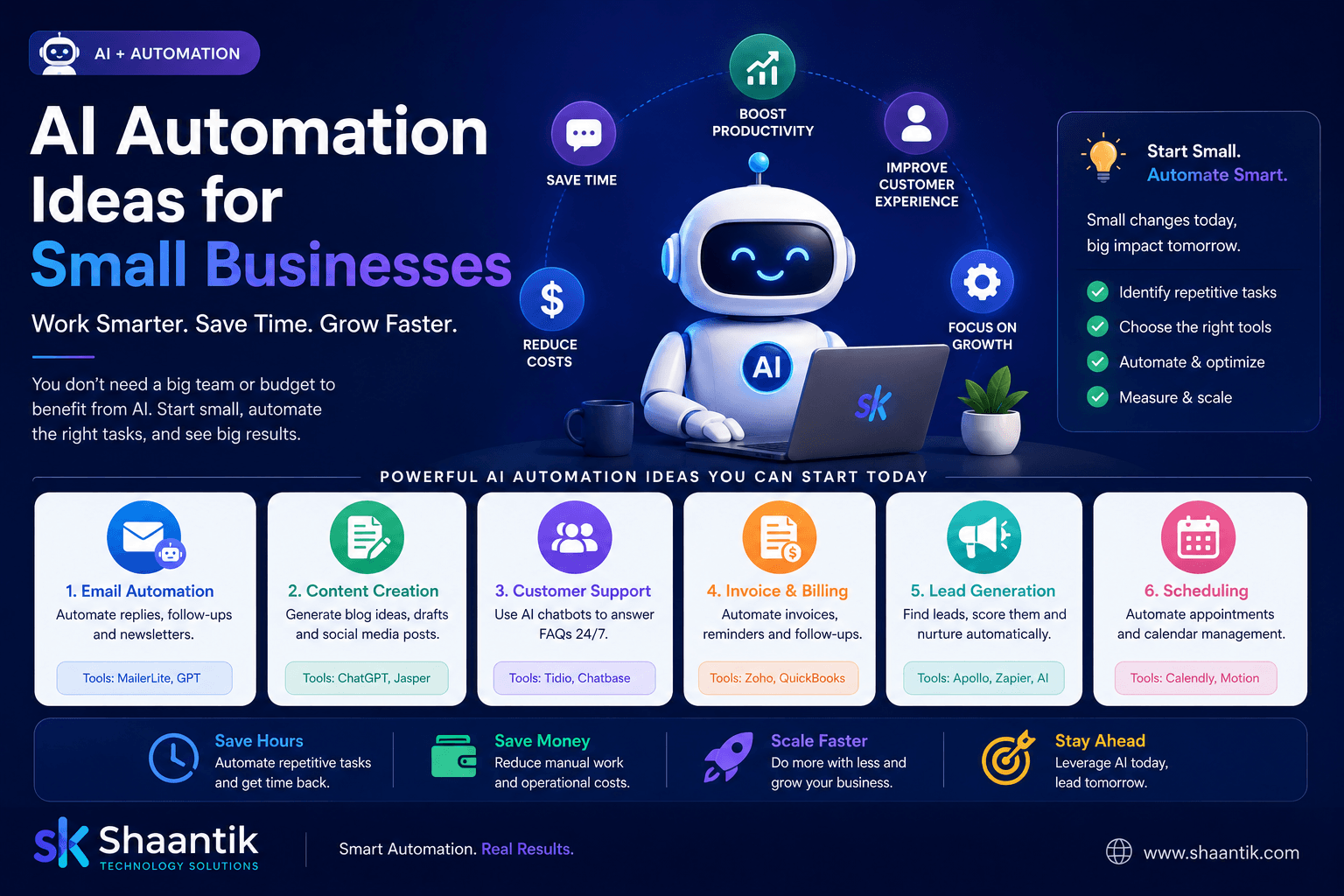
Introduction
AI is useful when it removes repetitive work—not when it creates another dashboard nobody opens. The best SMB automations start with a painful weekly task and a clear success metric.
You do not need a research lab. You need a pilot with approved content, an escalation path to a human, and measurement for hours saved or response time improved.
Here are ten ideas teams actually ship. For implementation help, see Shaantik AI automation or get in touch.
1–4. Customer-Facing Automations
These reduce response time and keep humans focused on edge cases.
- Website FAQ assistant grounded in your approved help content.
- Lead qualifier that asks 3–5 questions before booking a call.
- WhatsApp / email first-response drafts for common inquiries.
- Review-request sequences after a successful delivery.
Guardrails
- Only answer from approved documents.
- Escalate pricing, legal, and complaints to a person.
- Log conversations for weekly quality review.
5–8. Sales and Operations Automations
These cut admin work after the lead is already interested.
- CRM note summarization after discovery calls.
- Lead routing by service type, city, or deal size.
- Proposal outline generation from a structured brief.
- Invoice / payment reminder drafts with human approval.
Keep money-moving actions behind approval. AI should draft; people should send.
9–10. Internal Knowledge and Reporting
- Searchable knowledge base over SOPs and past project docs.
- Weekly KPI narrative: what changed, why, and what to do next.
Internal tools often pay for themselves faster than public chatbots because staff use them every day and mistakes stay inside the company.
How to Choose the First Pilot
Pick one workflow, not ten. Success needs a narrow scope.
- High volume + repetitive + clear rules.
- Easy to measure (hours saved, response time, conversion).
- Low risk if the model is wrong (easy escalation path).
- Content already exists (FAQs, SOPs, CRM fields).
A Simple 4-Week Rollout
- Week 1: Map the workflow and success metric.
- Week 2: Connect data sources and draft prompts/guardrails.
- Week 3: Internal pilot with 2–3 power users.
- Week 4: Fix failure cases, then limited production release.
A focused pilot often ships in a few weeks. Tell us your bottleneck and we’ll recommend a practical first build with AI automation.
Conclusion
Practical AI automation is an operations upgrade: faster replies, cleaner CRM, fewer repetitive tasks. Start with one measurable workflow and expand only after it earns trust.
Skip vanity demos. Ship something your team uses on Monday morning.
Frequently Asked Questions
Will AI replace my team?
No. Good automation handles repetitive steps so people can focus on judgment, relationships, and exceptions.
Do I need a huge dataset?
Not for many pilots. Start with your FAQs, SOPs, CRM fields, and a clear workflow.
What is a realistic first project?
A support or lead-qualification assistant with escalation to a human is a common, high-ROI starting point.
How do you keep answers accurate?
Ground the system in approved content, test failure cases, and require human review for high-risk actions.
Related service: Salesforce Consulting — Shaantik Salesforce consulting for Sales Cloud, Service Cloud, Flow automation, custom objects, dashboards, integrations, and CRM adoption training.