Local SEO Checklist for Small Businesses (2026)
A practical local SEO checklist to improve Google Maps visibility, local pack rankings, and phone calls—without chasing vanity traffic. Use it to fix your profile, citations, reviews, and location pages step by step.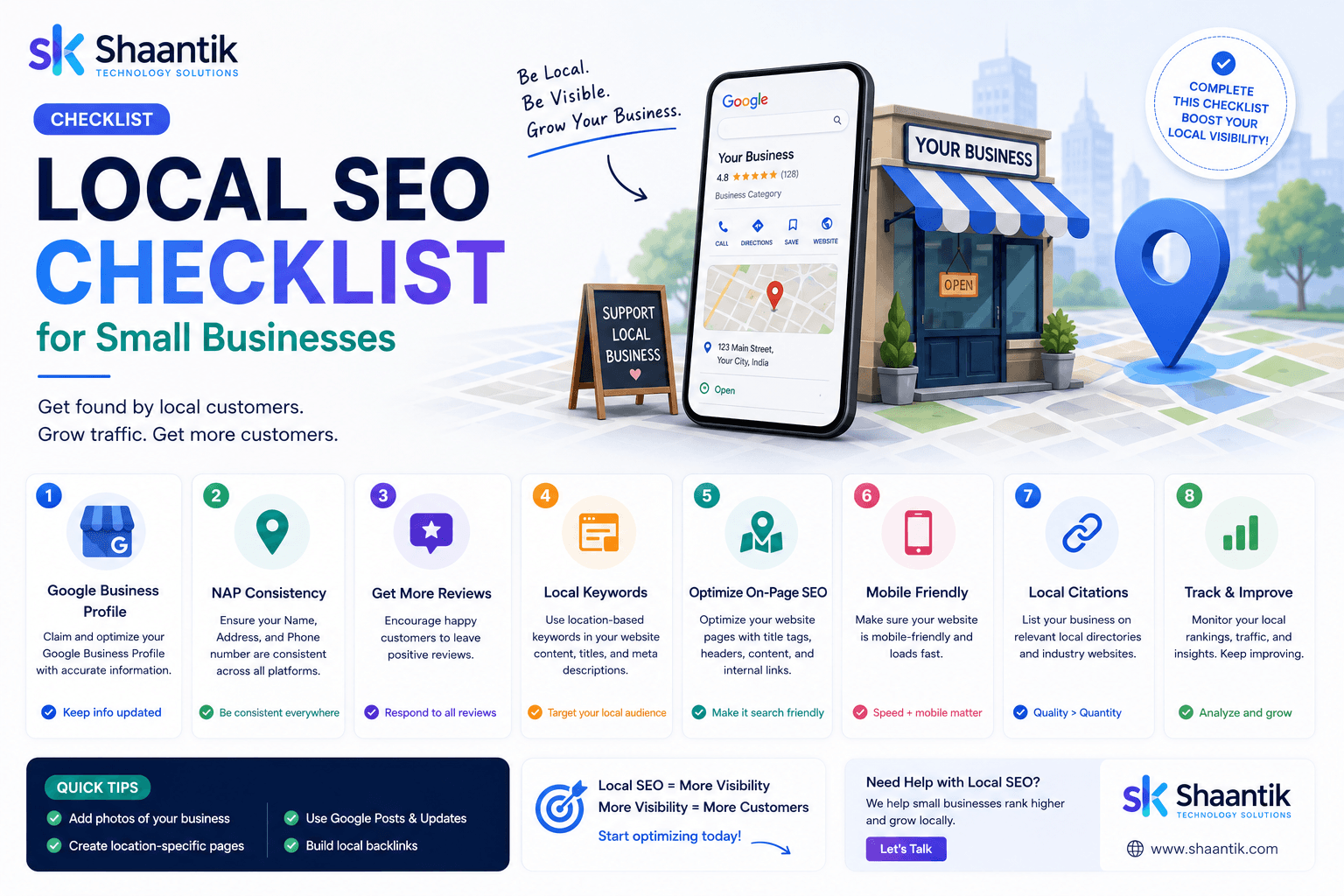
Introduction
Local SEO is how nearby customers find you when they search “near me,” your city, or your service area. For clinics, agencies, contractors, and multi-location brands, it often drives higher-intent leads than broad national keywords.
Most local ranking problems are not mysterious algorithm changes. They come from incomplete profiles, messy NAP data, thin location pages, and inconsistent reviews.
This checklist covers the foundations that move Maps visibility and phone calls. If you want help implementing it end-to-end, see our SEO strategy service or contact Shaantik.
1. Claim and Complete Google Business Profile
An incomplete profile is the fastest way to lose the local pack. Google needs accurate category, hours, services, and photos to trust your listing.
How to Fix It
- Claim and verify every location you serve in person.
- Use the exact business name customers know (no keyword stuffing).
- Set primary category carefully, then add relevant secondary categories.
- Add services, hours, phone, website, and appointment/booking links.
- Upload real photos of your work, team, and location every month.
2. Make NAP Consistency Boring (and Perfect)
Name, Address, and Phone (NAP) must match across your website, Google profile, and major directories. Small mismatches confuse Google and customers.
How to Fix It
- One canonical address format on every page.
- One primary phone number for tracking where possible.
- Update closed locations instead of leaving stale listings.
- Fix footer, contact page, and schema markup so they match.
3. Build Location Pages That Convert
A homepage alone rarely ranks for every city you serve. Create focused location or service-area pages with unique proof—not copy-paste city names.
What Strong Location Pages Include
- Clear H1 matching the local intent.
- Service details, FAQs, and trust signals.
- Embedded map and clickable phone CTA on mobile.
- Internal links from relevant blog posts and service pages.
- Real photos or project examples from that area when possible.
4. Reviews as a Ranking and Conversion System
Reviews influence both local pack rankings and whether a stranger calls you. Volume, recency, and replies all matter.
How to Fix It
- Ask happy customers for Google reviews with a short, easy process.
- Respond to every review professionally—positive and negative.
- Never buy fake reviews; they create risk and distrust.
- Track review velocity monthly like any other growth metric.
5. Citations, Technical Basics, and Tracking
Citations reinforce trust. Technical basics make sure Google can crawl your location pages. Tracking proves which searches turn into calls.
Priority Checklist
- Clean top citations (directories that matter in your industry).
- Ensure mobile speed, HTTPS, and indexable location pages.
- Submit an updated sitemap after publishing new location pages.
- Track calls, form leads, and Maps actions in analytics.
6. A 30-Day Local SEO Sprint
If your team is busy, run a focused month instead of a vague “SEO project.”
- Week 1: Profile completion + NAP cleanup.
- Week 2: One strong location/service-area page live.
- Week 3: Review request process + citation cleanup.
- Week 4: Internal links, tracking QA, and Search Console review.
Conclusion
Local SEO compounds: accurate profile data, consistent NAP, useful location pages, and steady reviews beat one-off ranking tricks.
Start with Profile + NAP + one strong location page, then expand. Need a hands-on audit? Talk to Shaantik about SEO strategy.
Frequently Asked Questions
How long does local SEO take?
Foundations can improve visibility in weeks, but competitive local packs often take 2–4 months of consistent work.
Do I need a separate page for every city?
Only where you genuinely serve and can add unique content. Thin city pages can hurt more than help.
Are paid ads a substitute for local SEO?
Ads can fill the pipeline quickly, but organic Maps presence compounds. Many businesses use both.
What is the first thing to fix?
Google Business Profile completeness and NAP consistency. Those unblock almost everything else.
Related service: SEO Strategy — Shaantik SEO services covering technical audits, keyword strategy, on-page optimisation, content clusters, schema markup, Core Web Vitals, and ranking reports.