React Native vs Flutter in 2025: What Should You Choose for Your App?
Choosing between React Native and Flutter in 2025 depends on your team skills, UI needs, hiring plan, and long-term maintenance. Here’s a practical, business-first comparison.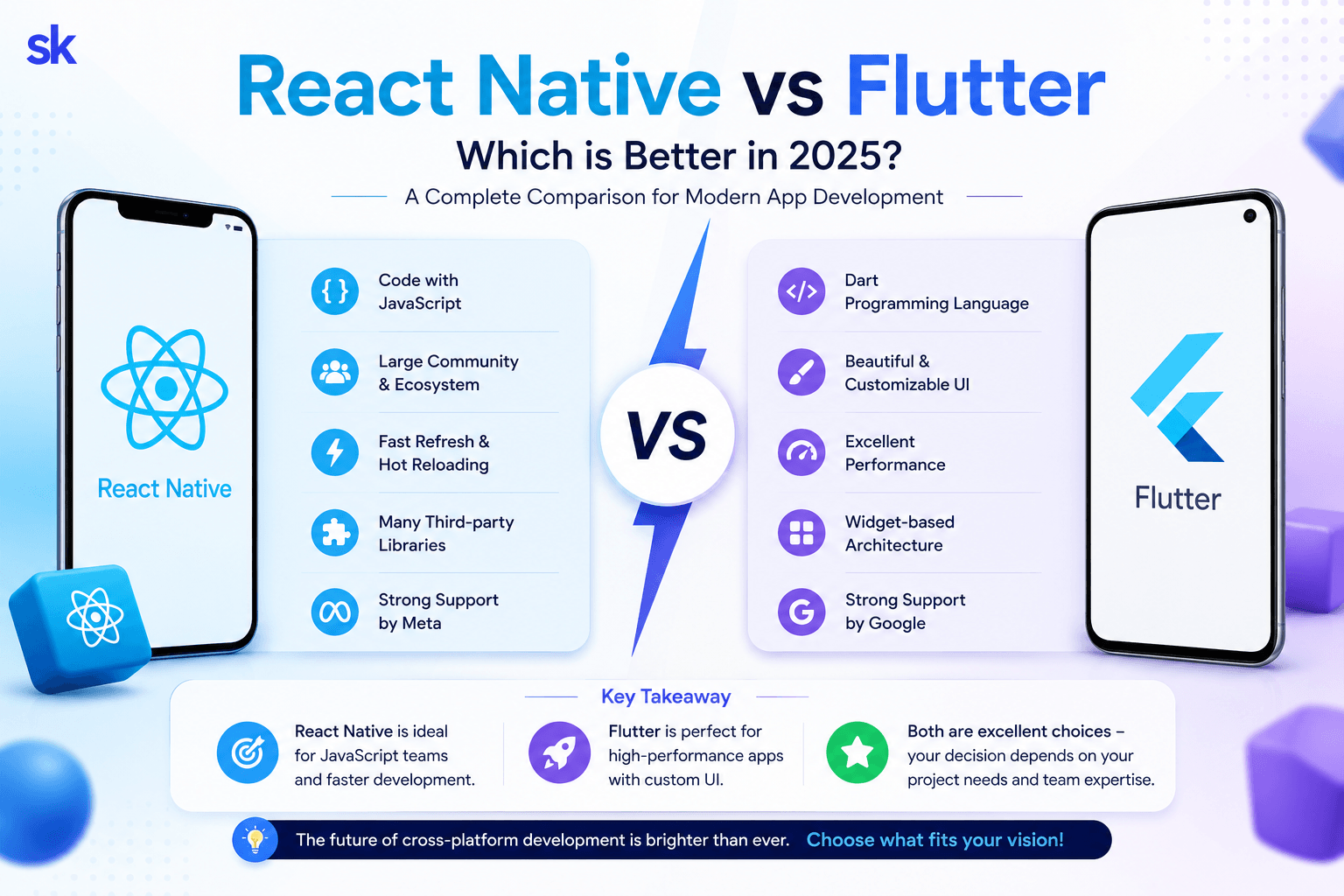
Introduction
Cross-platform frameworks help teams ship iOS and Android apps faster without maintaining two completely separate codebases. In 2025, React Native and Flutter remain the two most common choices for startups and growing businesses.
The wrong decision is usually not about which framework is “better” in absolute terms. It is about which one your team can build, hire for, and maintain for the next three to five years.
This guide compares both options with a practical decision framework you can use before development starts. Building an app soon? See our mobile app development service or contact Shaantik.
1. Team Skills and Hiring Reality
If your team already works in React and TypeScript, React Native often reduces onboarding time. Flutter can be excellent, but it requires comfort with Dart and Flutter-specific patterns.
Decision Tips
- Choose React Native when web and mobile share talent.
- Choose Flutter when you can invest in a dedicated Flutter team.
- Check local hiring availability before locking the stack.
- Plan for senior ownership—not only junior delivery speed.
2. UI Control and Design Systems
Flutter gives strong control over pixel-consistent UI across platforms. React Native leans on native components and a large ecosystem of libraries.
How to Decide
- Pick Flutter for highly custom branded interfaces.
- Pick React Native when native look-and-feel and web reuse matter.
- Audit complex animations and offline flows early in prototypes.
- Define a design system before feature velocity becomes chaos.
3. Performance and Native Integrations
Both frameworks can deliver smooth consumer apps. Performance issues usually come from architecture choices, heavy lists, unoptimized images, or poorly planned native modules—not from the framework alone.
Best Practices
- Prototype your riskiest screens first.
- Measure startup time, scroll performance, and API latency.
- Confirm camera, payments, maps, and push notifications early.
- Keep business logic testable and separate from UI widgets.
4. Long-Term Maintenance and Release Process
Shipping v1 is easier than maintaining v3. Library maturity, upgrade paths, CI/CD, and store release discipline matter more than launch-week speed.
Maintenance Checklist
- Document upgrade policy for major framework releases.
- Set automated tests for critical user journeys.
- Plan crash monitoring and analytics from day one.
- Budget for ongoing refactoring, not only new features.
Conclusion
React Native is often the better default for teams already strong in React. Flutter is a strong choice when UI consistency and a dedicated mobile stack are strategic priorities.
Choose the framework your organization can support confidently—not the one with the loudest online debate. Need a scoped build plan? Talk to Shaantik about iOS and Android app development.
Frequently Asked Questions
Is Flutter faster than React Native?
It depends on the app. Both can be fast when architecture and assets are handled well.
Which is better for startups in 2025?
The better option is the one your team can hire for and maintain. For many JS/TS teams, that is React Native.
Can I switch later?
Switching frameworks is expensive. Validate with a prototype before committing the full product.
Do I still need native developers?
Often yes for advanced modules, store releases, and performance tuning—even with cross-platform frameworks.
Related service: Mobile App Development — Shaantik designs and builds iOS and Android apps with React Native, native development, API integrations, App Store launch support, and analytics setup.