Website vs Landing Page: When You Need Each (And Why Mixing Them Fails)
A clear guide to when you need a full website, a focused landing page, or both—so paid ads and SEO don’t fight each other, and every click has a matching conversion path.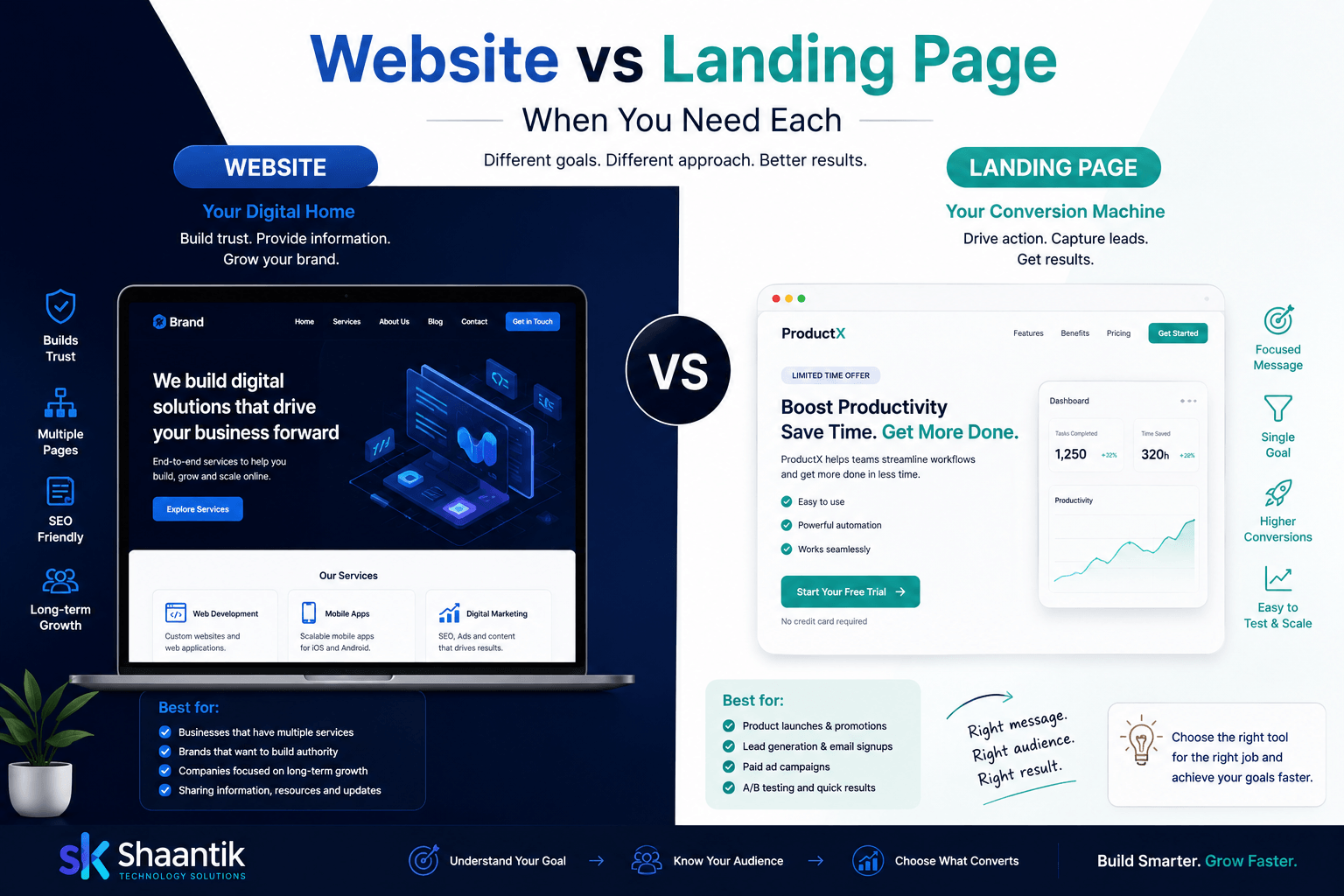
Introduction
Teams often send paid traffic to a homepage—or try to rank a single landing page for every query. Both waste money. Websites and landing pages solve different jobs.
A website builds long-term trust and SEO equity. A landing page wins a single campaign conversation. When you mix those jobs, conversion rates drop and reporting gets muddy.
Use this guide to choose the right surface for SEO, ads, and trust. For builds that convert, see website development and digital marketing.
1. What a Website Is For
A website is your owned presence: multiple pages, navigation, proof, and content that compounds over time.
- SEO for many intents (services, locations, blog topics).
- Trust building: about, projects, pricing, contact.
- Ongoing content and brand storytelling.
- Multiple conversion paths, not one offer only.
2. What a Landing Page Is For
A landing page is a focused conversion surface—usually one offer, one audience, one CTA.
- Paid campaigns (Google Ads, Meta Ads).
- Product launches and webinars.
- Lead magnets and seasonal offers.
- A/B tests where message match matters.
Landing Page Essentials
- Headline that mirrors the ad.
- One primary CTA above the fold.
- Proof near the form.
- Minimal navigation distraction.
3. Why Mixing Them Fails
Sending ad traffic to a busy homepage with five competing CTAs usually lowers conversion rate. Trying to rank a thin campaign page for every service query usually fails SEO.
- Message mismatch between ad and page kills Quality Score and ROAS.
- Too many exits on a paid landing page leak attention.
- Thin pages rarely earn durable organic rankings.
- Reporting blurs: you cannot tell which offer actually won.
4. When You Need Both
Most growing businesses need both: a durable website for organic trust and SEO, plus campaign landing pages that match ad copy.
- Keep the website as the authority hub.
- Create campaign landing pages with matching headlines and offers.
- Send landing-page leads into CRM / follow-up automation.
- Reuse website case studies as proof blocks on landing pages.
- Retarget landing-page visitors with nurture sequences.
5. A Simple Decision Framework
- Organic discovery + multiple intents → website pages.
- Paid campaign + one offer → landing page.
- Brand credibility needed before purchase → website proof + landing CTA.
- Unsure? Build the website foundation first, then add campaign pages as ads scale.
If your ads underperform or your site doesn’t convert, Shaantik can help redesign the path.
Conclusion
Don’t force one page to do every job. Websites build long-term equity; landing pages win short, paid attention.
Get the structure right once, then scale campaigns without rebuilding your whole site for every offer.
Frequently Asked Questions
Can a landing page rank on Google?
Sometimes, but thin single-offer pages rarely beat a well-structured service page with proof and depth.
Should every ad go to the homepage?
Usually no. Message match between ad and page is one of the biggest conversion levers.
How many landing pages do I need?
Start with one per major offer or audience. Expand when campaigns justify the creative and testing cost.
Can Shaantik build both?
Yes. We often deliver the website foundation and campaign landing pages as one coordinated engagement.
Related service: Website Development — Shaantik builds fast, SEO-ready custom websites, landing pages, and e-commerce platforms with React, Next.js, CMS integrations, and conversion-focused design.